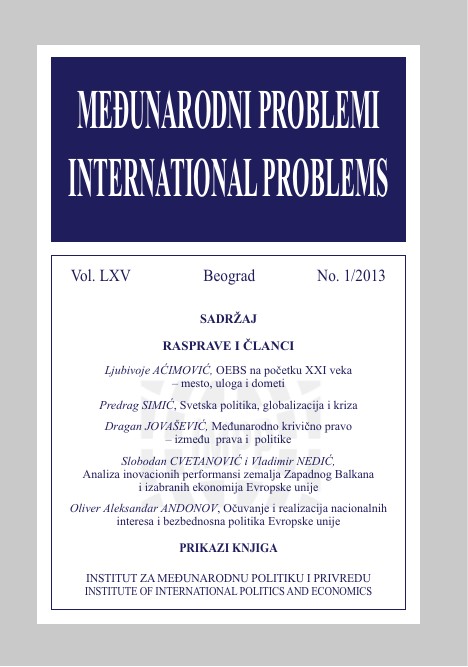
International problems Vol. 65 No. 1/2013
Content
Ljubivoje AĆIMOVIĆ
International problems, 2013 65(1):7-23
Abstract ▼
The author firstly deals with the genesis and evolution of the Organization for Security and Co-operation in Europe comparing the basic characteristics of OSCE with those of the previous CSCE. Then follows an analytical survey of the CSCE/OSCE activities in the 1990s, which are grouped into the following three fields: institutional build-up of the Organization, normative and programmatic activity as well as the operational and implementation activity. The author makes an analysis of the Charter for European Security adopted at 1999 OSCE Istanbul summit. The final part projects what further development and role of OSCE is likely to be in the field of security and co-operation in the Euro-Atlantic region, pointing out that in the foreseeable period OSCE will probably mainly retain its present role, significance and the structure of activities, unless some unexpected events occur in the sphere of international affairs.
Predrag SIMIĆ
International problems, 2013 65(1):24-41
Abstract ▼
In the early 21st century, globalization and the world economic crisis changed the balance of powers between the old (declining) and new (emerging) industrial states replacing the unilateral with a multilateral system of international relations and changing the way in which world politics was functioning. Globalization has increased the number of transnational problems (protection of human environment, international traffic and communications, flows of capital, energy, migrations, etc.) that require global governance. However, these trends also indicate that in the 21st century, international relations and world politics will function in a significantly different manner than they did within the bipolar and unipolar order, which characterized the second half of the 20th century.
Dragan JOVAŠEVIĆ
International problems, 2013 65(1):42-67
Abstract ▼
Crimes against international law are committed by violating the rules of international humanitarian law during wars or armed conflicts. The perpetrators of these crimes are under the jurisdiction of international criminal courts (military or civil, permanent or ad hoc). The process of the commission of crimes against international law may comprise several different phases or stadiums. Moreover, such criminal offences rarely appear as the results of only one person’s activities. On the contrary, in numerous cases of these criminal offences, accomplice appears as a form of collective participation of several persons in the commission of one or more crimes against international law. All these facts represent grounds for the specific type of criminal responsibility of the perpetrators of crimes against international law. It is a object of regulation international criminal law about whose characteristics converse this article.
Slobodan CVETANOVIĆ, Vladimir NEDIĆ
International problems, 2013 65(1):68-84
Abstract ▼
First of all, the paper offers a theoretical explication of the importance of economic innovation for a country’s economic development. It further considers the metrics of the Global Innovation Index. By means of a box-plot diagram, the article explores the link between basic innovation performances (Global Innovation Index, Index Innovation Input and Index Innovation output) of the six Western Balkan countries (Albania, Bosnia and Herzegovina, Macedonia, Serbia, Croatia and Montenegro) and a group of six selected European Union economies in the neighbourhood (Austria, Greece, Bulgaria, Romania, Hungary and Slovenia). The aim is to identify the existence of extreme values between the data that reveal the key innovation performance of the two groups including the description of the basic characteristics of the performances which have been examined.
Oliver Aleksandar ANDONOV
International problems, 2013 65(1):85-109
Abstract ▼
The objective of the research of connection between national interests and the security policy of the European Union is to perceive the possibilities of the Balkan states to preserve their identity and achieve their vital and permanent national interests by their membership in the European Union. According to the author, the implementation of the security policy of European Union is often opposite to one’s own national interests. However, a pragmatic question for political leaders is how to resolve the following dilemma: „is the created european security identity more important at the moment than the preservation of immediate or some permanent national interests“? The author points to the fact that the notion of national interests is a variable both historically and theoretically. Political, economic, security and other objectives determine vital national interests in some historical periods. At the same time, not rarely, some states alter their strategies and objectives for their own interests assessing whether the conditions prevailing in the internal and external surroundings have changed. The author devotes special attention to a comparative analysis of defining, determining and conceptual determination of national interests from the aspect of national security policies of some important states and the European Union. The second part of the article contains an analysis of the response of a group of Macedonian experts to the questions pertaining to the possibility of preserving and achieving of national interests of the Republic of Macedonia through its membership in the European Union.
Book review
ENVIRONMENTAL LAW IN SERBIA
Mihajlo VUČIĆ
International problems, 2013 65(1):111-113
THE FUTURE OF POWER
Dragana DABIĆ
International problems, 2013 65(1):113-116




 121.59 KB)